
Research Lab
For working groups that manage their invention work together.
Develop inventions from research visibly and guide them into commercialization: from the first idea in the lab through the invention disclosure to filing, license or spin-off.
Coming soon Universities, technology transfer offices and campus licenses follow after market launch.

For working groups that manage their invention work together.
For receiving, documenting and coordinating invention disclosures.
For several faculties and institutes with a central contract and budget.
For moving an invention into a spin-off.
| Variant | What is included |
|---|---|
| Research Lab | For a research group that works on inventions together. |
| Transfer Office Starter | Receive disclosures, assign roles, work with the law firm and commercialize. |
| Transfer Office Professional | Plus portfolio, transfer, remuneration and approvals. |
| Campus | For many institutes, with central roles and budgets. |
Technical invention work can be built up interactively: collect ideas, involve co-inventors and develop the invention model further together.

Schematic diagram of a possible process, not a product interface.
Before a publication come questions of timing, disclosure and rights. ErfinderWerk makes them visible and records questions between researchers and the technology transfer office. A person always makes the decision.
For inventions by university employees, § 42 of the Arbeitnehmererfindungsgesetz (German Employee Inventions Act, ArbnErfG) can set the framework. Whether it applies in an individual case depends on the employment relationship. Exceptions and the basis of commercialization also play a role. There is no general statement for students and spin-offs.
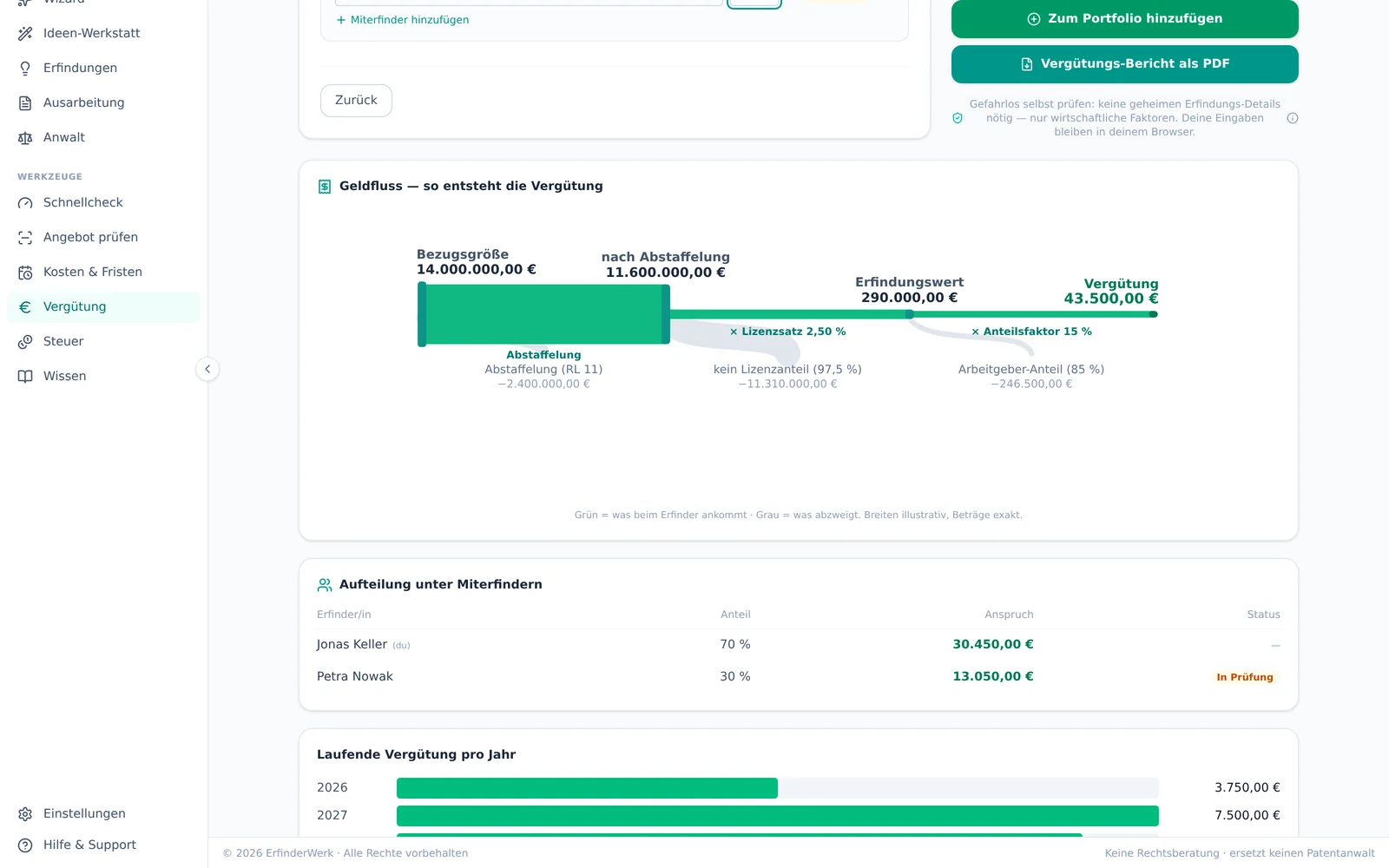
Remuneration is calculated in ErfinderWerk: the remuneration calculator based on the German guidelines calculates per inventor and per year, also across patent families. It is an aid, not legal advice: a qualified person, for example in your legal department or technology transfer office, checks the result.
Universities can connect their own AI, also on customer-owned AI servers. Partners for hardware and software apply as with Enterprise. The operating models are described on the page Enterprise.
Law firms review within the same case. The page Patent law firms shows how this looks; experts and partners are described in the Expert network.
If an invention is to become a company, rights, contributors and licenses must be transferred clearly. ErfinderWerk records who contributed what and what is released for the new space.
Coming soon Spin-offs are a later expansion stage.

Invention, inventor team and contributions remain traceable, with versions and evidence.
Only what authorized people release moves into the new space.
A right of use is different from a change of ownership. Both need approval by authorized people.
As viewers, they see only the excerpts that you release. You stay in control.
Schematic diagram of a possible process, not a product interface.
The pages on features and plans show what separates Lab, Transfer and Campus. Researchers join the waitlist themselves.